
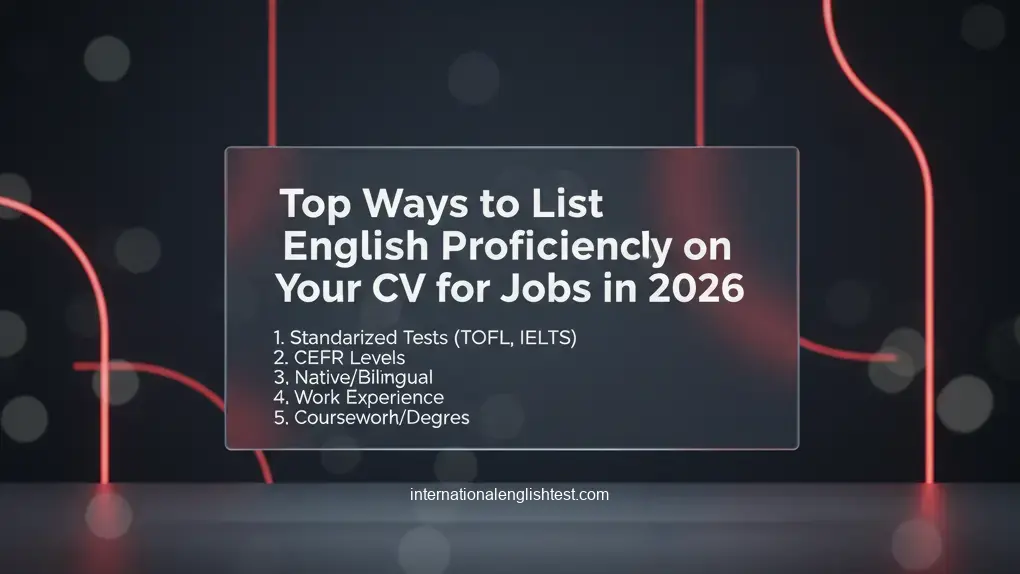
For jobs in 2026, list your English proficiency with your official CEFR level or most recent test score (like IELTS or TOEFL) plus a matching phrase (e.g., “C1 Advanced – IELTS 7.5”). HR teams and recruiters expect proof, not just a vague claim like “fluent” or “good.” Make it bold, make it real—your next job might depend on it.
Right now, most companies use global benchmarks like CEFR or official exams as a first filter for international candidates. If you want to prove your language skills to employers—or just check where you stand—it’s smart to find my CEFR level using an accredited online tool before you update your CV.
Comparison Table: English Proficiency Levels, Tests, and CV Phrases
Recruiters rely on hard evidence: a simple phrase matched with a recognized test score or CEFR level stands out. Think of it like showing your driver’s license rather than just claiming “I drive well”—one is trusted instantly, the other invites doubt. To help you match your real skills (or certificates) to what employers expect, use this table as your reference:
| CEFR Level | IELTS Score | TOEFL iBT Score | Typical CV Phrase |
|---|---|---|---|
| A2 (Elementary) | 3.0–3.5 | 0–30 | Basic working knowledge of English |
| B1 (Intermediate) | 4.0–5.0 | 31–56 | Intermediate English (B1, IELTS 4.5, TOEFL 50) |
| B2 (Upper-Intermediate) | 5.5–6.0 | 57–86 | Upper-Intermediate (B2, IELTS 6.0, TOEFL 72) |
| C1 (Advanced) | 6.5–7.5 | 87–109 | Advanced – C1 (IELTS 7.0, TOEFL 100) |
| C2 (Proficient/Native) | 8.0–9.0 | 110–120 | Native/Proficient (C2, IELTS 8.5, TOEFL 115) |
- Add your most recent and relevant certificate or test.
- Use a standardized phrase—avoid vague terms like “fluent.”
- If you’ve got multiple certificates, list the one that fits the job best.
How Employers in 2026 Verify English Skills During Hiring
Employers want proof—fast. By 2026, they’re not just asking if you speak English, they’re checking how and when you proved it. Top companies want external validation. HR usually starts with certificates—think IELTS, TOEFL, Cambridge English—and cross-checks them against your application. Many now request a digital badge or QR code so they can verify your score directly from source databases. If you can’t show proof, your claim may not even get a second look.
This trend is only growing: digital verification tools link directly to English exam providers, while online assessments—sometimes recorded live—act as instant spot-checks. Some employers will even skip the paperwork and invite you to a 10-minute live interview focused purely on communication, not small talk. It’s a bit like a fact-checker reviewing a reporter’s source—you’re either verified or you’re out.
For roles where English is a dealbreaker, companies check your profile against current requirements. One excellent reference for new expectations is English Certificate Requirements for Remote Jobs: 2026 Employer Expectations, which details the standards recruiters are using right now.
- Always clarify your test date—recent is almost always better.
- Be ready to prove your skills with an interview or quick online test.
- Don’t fudge the facts. You’ll be found out quickly.
Visa, Work Permit, and Salary Impact of English Proficiency in CVs
English skills can be the key to a work permit or migration—literally. Governments set clear language standards for foreign workers, especially in high-demand sectors. Miss the target score, and your paperwork doesn’t move. Detail your CEFR level or recognized test (including score and test provider) directly on your CV.
Want more money, too? Strong English equals higher salary negotiations—ask any recruiter who hires for international teams. It’s like being the only player in a game who knows the secret strategy. The market rewards proven skill. If you show a top-tier certificate, you gain leverage, especially when moving into client-facing or leadership roles. Even a B2 (Upper-Intermediate) certification can boost your starting offer in fields like tech, finance, and healthcare.
- Always use a certificate recognized by the country where you want to work.
- List your English clearly on your CV and job applications—don’t hide it at the end.
- Higher skills = more opportunities and better paychecks.
Tonight, find your most recent English certificate and check the expiration date. If it’s older than two years—or you don’t have one—sign up for an online test this week. A fresh, trustworthy result is your fastest shortcut to a stronger CV and better job offers in 2026.
FAQ
Should I list my English level as ‘fluent’ or use a CEFR grade?
Use the CEFR grade and add any recent test score. “Fluent” alone is too vague; employers want measurable proof in 2026.
What if I don’t have a certificate?
Take a reputable online assessment and add your result, even if it’s unofficial. Employers would rather see a current score than nothing at all.
Which tests are most accepted for CVs in 2026?
IELTS, TOEFL iBT, Cambridge English, and the International English Test (IET) are all widely recognized. Choose the one that matches job or visa requirements.
Is it better to show an old high score or a recent lower one?
A recent score, even if slightly lower, is more credible for most employers. Many require results from the past two years.
Where does English proficiency belong on my CV?
Include it in a dedicated “Languages” section or in your professional summary if English is a main job requirement. List your level, score, and test provider for clarity.