

Whether you’re applying to a university abroad, seeking a new job in an international company, or simply want to prove your language skills to the world, an English certification can open doors that would otherwise remain closed. But with so many options on the market, how do you know which one to choose?
This guide breaks down the most widely recognized English certifications, who they’re for, and what you need to know before signing up.
Why Get Certified?
English proficiency certificates serve as an internationally accepted proof of your language ability. Employers, universities, and immigration authorities around the world use them to assess candidates objectively. Beyond the practical benefits, preparing for a certification exam can also sharpen your reading, writing, listening, and speaking skills in ways that informal learning rarely achieves.
IELTS — International English Language Testing System
IELTS is arguably the world’s most popular English certification, with over 3.5 million tests taken each year. It’s co-owned by the British Council, IDP Australia, and Cambridge Assessment English, giving it a strong footprint across multiple continents.
There are two versions: the Academic module, designed for those applying to universities or professional registration, and the General Training module, used primarily for immigration purposes (especially to the UK, Canada, and Australia) and vocational programs. Scores are reported on a band scale from 1 to 9, and most universities require a band of 6.5 or above for admission.
IELTS is accepted by over 11,000 organizations worldwide and is one of the few English tests recognized for immigration to the UK, Australia, Canada, and New Zealand.
TOEFL iBT — Test of English as a Foreign Language
The TOEFL iBT (Internet-Based Test) is administered by ETS (Educational Testing Service) and is especially dominant in North American universities. If you’re aiming for a U.S. or Canadian institution, TOEFL is often the default requirement.
The test is fully computer-based and integrates all four skills — reading, listening, speaking, and writing — in tasks that mimic real academic scenarios. Scores range from 0 to 120, and most top universities require a minimum of 80–100. TOEFL is accepted by more than 11,500 universities and institutions in over 160 countries.
One feature that sets TOEFL apart is the MyBest Scores option, which allows test-takers to combine their best section scores from multiple test attempts — a useful advantage for those who excel in different areas on different days.
International English Test (IET)
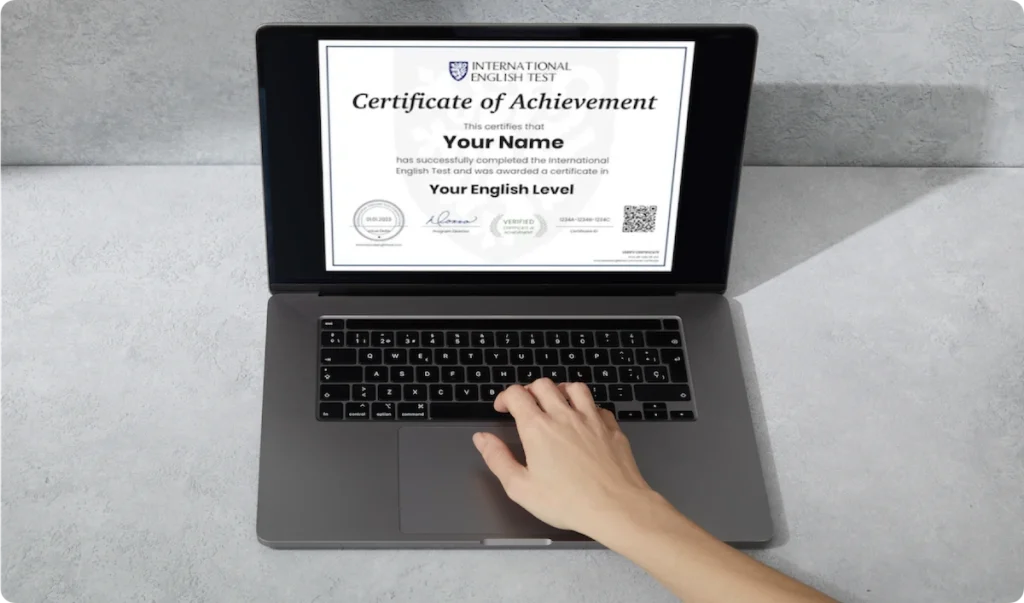
The International English Test (IET), available at internationalenglishtest.com, is a fully online, CEFR-aligned certification platform aimed at students and professionals who need a quick, affordable proof of their English level. The test covers all four core skills — reading, listening, writing, and speaking — and uses AI-powered scoring to deliver results and a downloadable certificate almost instantly after completion.
Certificates are issued for levels A1 through C2 and can be verified online via the test-taker’s name and a unique Test ID, or through a QR code on the certificate itself. The platform positions itself as a budget-friendly alternative to traditional high-stakes exams, making it particularly appealing for CV and LinkedIn profile updates, internal company assessments, and Erasmus program requirements.
It’s worth noting that IET is a newer and more niche player compared to the established names on this list. While the platform claims broad institutional acceptance and holds an Associate Member status with ALTE (the Association of Language Testers in Europe), its recognition is not yet universal, and prospective test-takers should verify acceptance with their specific target institution or employer before enrolling.
Cambridge English Qualifications
Cambridge offers a suite of qualifications at different levels of the Common European Framework of Reference for Languages (CEFR). These certifications never expire, unlike IELTS and TOEFL, which are typically valid for two years.
The most recognized Cambridge exams include:
B2 First (FCE) — Aimed at upper-intermediate learners, this is a widely used certification for academic and professional purposes across Europe.
C1 Advanced (CAE) — Targeting high-level users, C1 Advanced is accepted by thousands of universities and employers. It’s a popular choice in the UK and Europe for those who want a lifetime certificate at a level that demonstrates genuine fluency.
C2 Proficiency (CPE) — The highest level Cambridge offers, C2 Proficiency is recognized as proof of mastery of English. It’s often sought by those who want to work or study in highly competitive environments where native-level proficiency is expected.
Cambridge exams are recognized by over 25,000 organizations globally and are particularly strong in European, Latin American, and Asian markets.
PTE Academic — Pearson Test of English
PTE Academic is a computer-based exam developed by Pearson and is one of the fastest-growing English certifications in the world. Results are typically available within 48 hours, making it a popular option for applicants on tight timelines.
PTE uses AI-based scoring, which removes human bias from the assessment process. It’s accepted by thousands of universities and colleges worldwide and is approved for student and skilled worker visas in Australia, the UK, and New Zealand. Scores range from 10 to 90, and the test is known for its innovative integrated task format, where skills are assessed together rather than in isolation.
TOEIC — Test of English for International Communication
Unlike the other certifications on this list, TOEIC is designed specifically for the workplace rather than academic settings. It measures the English skills needed in everyday business and professional environments — think meetings, emails, presentations, and phone calls.
TOEIC comes in several formats: the Listening and Reading test (the most widely used), and the Speaking and Writing tests. It’s especially popular in France, Japan, South Korea, and parts of Latin America, where many companies use it as a benchmark for hiring and internal promotions. Scores range from 10 to 990.
Duolingo English Test
A relative newcomer to the space, the Duolingo English Test (DET) has gained significant traction since 2020, particularly as universities around the world adopted remote admissions processes during the pandemic. It can be taken from home in about an hour, costs significantly less than traditional tests, and results are usually available within two days.
Scores range from 10 to 160, and the test is now accepted by over 5,000 programs worldwide, including many top universities. While it may not carry the same universal recognition as IELTS or TOEFL, its convenience and accessibility have made it a legitimate option for many applicants.
How to Choose the Right Certification
The best certification for you depends on your goal. If you’re applying to a U.S. university, TOEFL or IELTS are the safest choices. For European universities and jobs, Cambridge qualifications or IELTS tend to be preferred. For immigration to Australia, Canada, or New Zealand, IELTS and PTE Academic are the most widely accepted. If your goal is career advancement in a global company, TOEIC may be the most relevant measure.
It’s always worth checking the specific requirements of the institution or employer you’re targeting before committing to a test. Many organizations accept multiple certifications, so you may have more flexibility than you think.
Final Thoughts
Earning an English certification is an investment — in time, money, and effort. But it’s one that pays dividends across your academic and professional life. Whether you choose the global prestige of IELTS, the academic rigor of TOEFL, the permanence of a Cambridge certificate, or the speed and convenience of PTE or Duolingo, what matters most is that you choose the one that aligns with your specific goals and prepare for it thoroughly.
Good luck — and remember, the exam is not just a gate to pass through, but a measure of real skills you’ll use every day.