
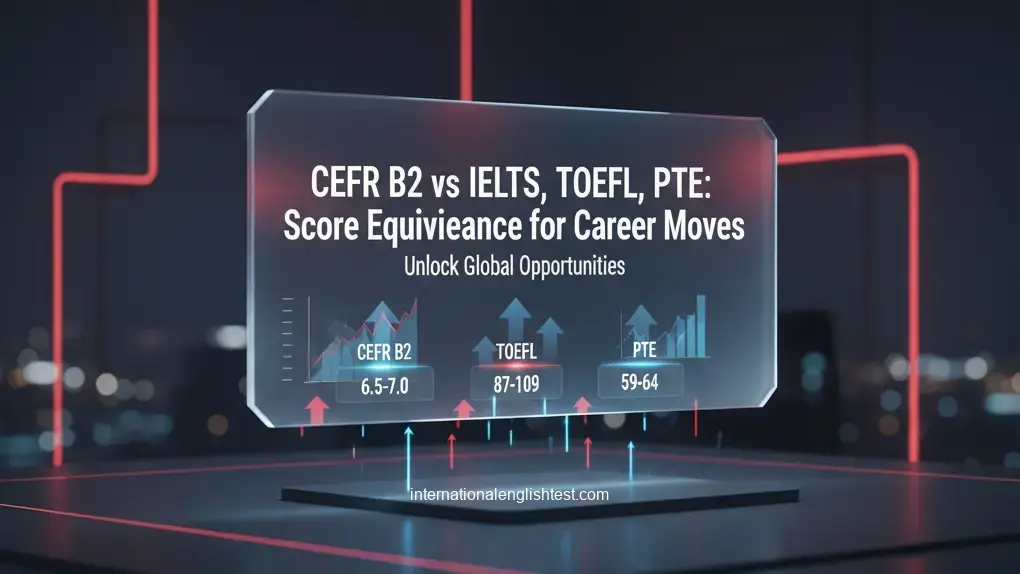
CEFR B2 typically matches an IELTS score of 5.5–6.5, TOEFL iBT 72–94, and PTE Academic 59–75. These levels satisfy job eligibility and migration requirements in many English-speaking environments. Employers and migration officers often accept scores within these bands as proof of upper-intermediate proficiency.
Proving your English level with an official score can mean the difference between shortlisting and rejection in international hiring. If you want to see where you stand before applying, you can test my English and compare your results.
CEFR B2, IELTS, TOEFL, PTE: Score Comparison Table for Job Requirements
Recruiters and HR managers often need a way to match job requirements with language test results. Here’s a direct reference—the closest equivalence between CEFR B2 and major international test scores.
| Exam | B2 Score Range | Validity Period | Global Recognition |
|---|---|---|---|
| CEFR B2 | Upper-Intermediate | N/A | Europe, global employers |
| IELTS Academic/General | 5.5–6.5 | 2 years | Universities, migration offices |
| TOEFL iBT | 72–94 | 2 years | US, Canada, employers worldwide |
| PTE Academic | 59–75 | 2 years | Australia, New Zealand, UK |
| International English Test (IET) | B2 Certificate Issued | 2 years | Global (subject to employer acceptance) |
- Always check employer or government requirements for accepted exams.
- B2 is generally the minimum for professional and academic roles abroad.
- Valid certificates must usually be less than 2 years old.
Why Employers Value CEFR B2 and Equivalent Language Test Scores
You might think an English test is just a formality, but for HR, these levels are shorthand for real communication ability. Busy recruiters sort hundreds of CVs; proof of B2 can move yours from the “maybe” pile to the interview shortlist. It’s much like scanning a barcode—one quick check for eligibility, no emotional guesswork.
Industries that handle international clients—tech, tourism, finance, healthcare—often insist on B2 or above. Jobs like customer support, nursing, sales, IT project coordination, and engineering all demand you understand instructions and contribute clearly in meetings. In some sectors, written skills matter more, especially where technical documentation or contracts are routine. The rule: if you collaborate internationally, B2 is the line in the sand.
- Corporate HR teams use B2 as a global benchmark
- Client-facing and remote roles almost always list B2 equivalence in job ads
- A B2 certificate means you won’t slow down the team with avoidable miscommunications
Migration, Work Permits, and CEFR B2: Language Proof for 2026
Governments don’t just want to see graduation papers—they want clear, comparable English proof for work permits. B2 is the most common cut-off for skilled migration across Europe, Australia, Canada, and the UK. If you’re eyeing 2026 or later, expect documentation rules to get tighter still.
Recognized certificates include IELTS, TOEFL, PTE, IET, and a few others listed officially. Certificates typically remain valid for two years from test date. Some government portals require direct report uploading from the official test provider—no scanned copies, no iffy translations. For the specifics on student routes, you can review Which CEFR Certificates Does Germany Recognize for Student Visas? to check if your document qualifies.
Much like submitting a tax return, exact documentation matters more than personal justification. If your certificate isn’t on the approved list or it’s expired, expect an automatic rejection with no appeal. Keep your language proof current, organized, and officially certified.
Improving Your CEFR B2 Score for Promotions and Salary Growth
Anyone can get stuck at B2—moving to C1 or above takes an intentional strategy. It’s like aiming for a marathon after jogging 10k—natural progress only takes you so far. To unlock management positions or international assignments, you often need to show you haven’t plateaued. Employers know the difference between “surviving in English” and “thriving as a leader.”
Professional upskilling is available everywhere: internal workshops, sponsored online courses, and industry-specific tutorials built around raising scores. If your company offers a language learning budget and you let it expire, that’s on you. Leverage real conversations, targeted CEFR or IELTS/PTE/TOEFL prep, and continuous skill checks. Proactive upskilling pays back quickly—sometimes with a bonus, sometimes with job security.
- Demand employer sponsorship for advanced English training
- Build a weekly routine with learning targets, not just practice tests
- Pair with a language coach for feedback on presentations or emails
If you want to boost your test confidence fast—set aside 30 minutes today to complete a full-length practice of your weakest skill (reading, writing, listening, or speaking). Immediately review your answers, spot one recurring mistake, and write down how you’ll fix it next time. Small, rapid feedback loops move you forward faster than marathon cramming sessions.
FAQ
Is CEFR B2 enough for most jobs abroad?
Yes, B2 is typically the minimum for professional roles and skilled migration, but some jobs—especially in management—prefer C1 or above.
How long are IELTS, TOEFL, or PTE certificates valid for?
Most employers and governments accept language certificates for 2 years from the test date. Always check your target organization’s policy before applying.
Can I use International English Test (IET) results instead of IELTS or TOEFL?
Some employers and programs accept IET; others ask specifically for IELTS, TOEFL, or PTE, so verify the recognition list before booking your test.
What happens if my English score certificate is expired?
You’ll need to retake the exam. Expired certificates are almost always rejected for work permits or visa applications.
What’s the fastest way to improve from B2 to C1?
Target your weakest skill, get feedback weekly, and use English daily at work or in real conversations. Intentional, focused practice speeds up improvement.